Thursday, June 9, 2011
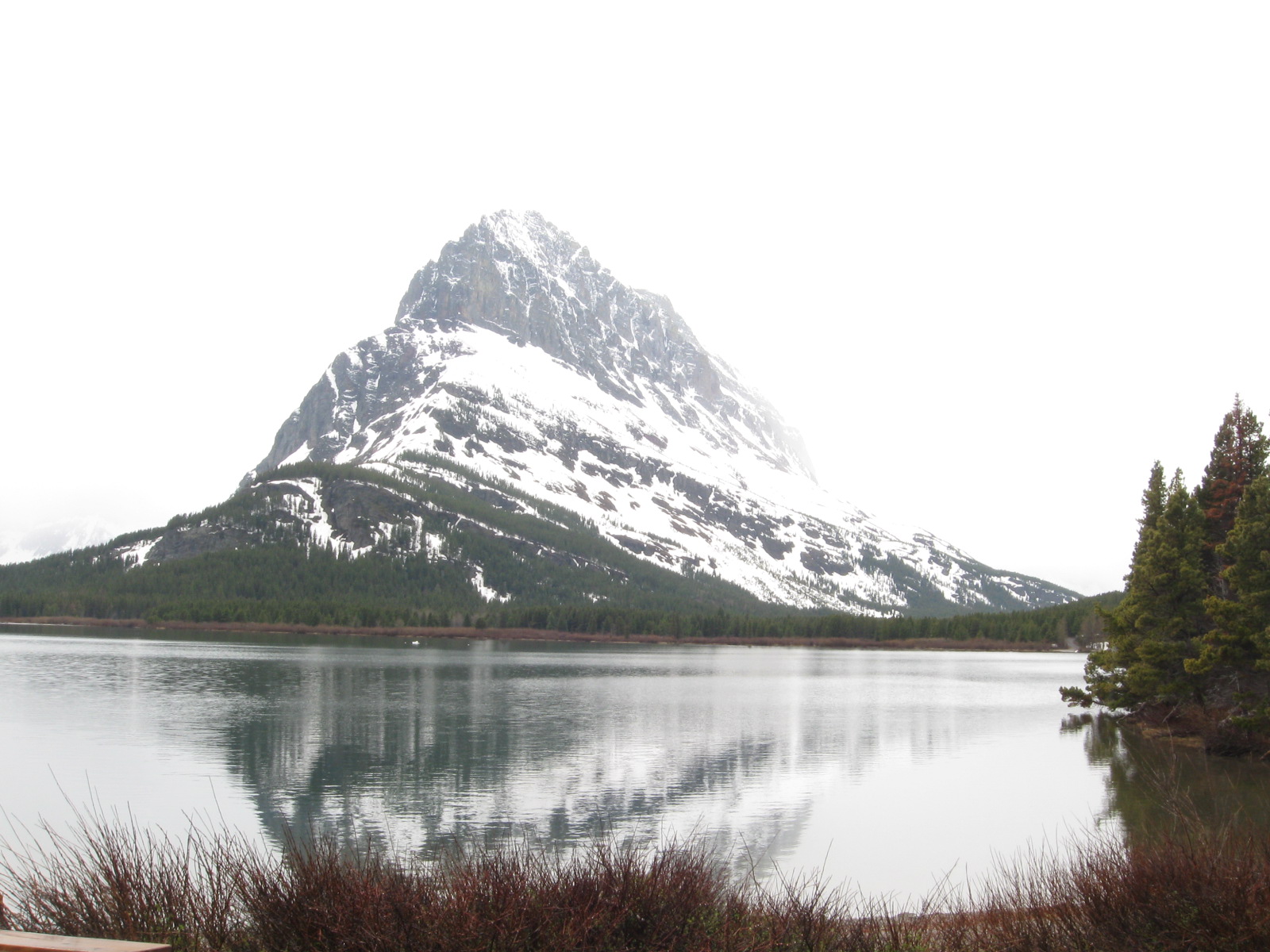
Black Bears and Glacier's Saint Mary Lake
On May 30, we drove US Route 2 and Route 89 to visit East Glacier and the eastern portion of Going-to-the-Sun Road due to road closure from Avalanche Creek to Jackson Glacier Overlook.
The scenic drive along US Route 2 led us drive from scenes of late spring to mid-spring then to early spring. We had sunshine, drizzling spring shower, then icy rain on our way to Jackson Glacier Overlook. It turned out the Saint Mary Visitor Center is the major entrance to the Glacier. Again, the views of those white glaciated mountains along Saint Mary Lake are spectacular and breathtaking. No much traffic, we have it all!
When we saw a mother black bear and her cub along the Going-to-the-Sun Road, we realized that we are truly in Bear Country.
The Going-to-the-Sun Mountain, from which the road takes its name, is right across the Jackson Glacier Overlook,and it is 9642ft or 2939m high. However, it didn't impress us much, probably because of the cold rain. Still, we walked in ponchos and winter coats all the way to Sunrift Gorge, hiked on the trail to the shore of Saint Mary Lake, came back out at Sun Point. With all these sunny names, we had to wait in rain for our Toyota Sienna to be picked up with the help of two park rangers. Rising Sun was ahead of us. I bet it would be a perfect place to see the rising sun... 20 years later?
Wednesday, June 8, 2011
Avalanches of Avalanche Creek Glacier National Park
Avalanche Creek is on the western portion of Glacier National Park's Going-to-the-Sun Road. While walking on the trail of Avalanche Creek, we finally know why it gets its name, because of all those thundering avalanches!
The view of Avalanche Creek Gorge is simply gorgeous and breathtaking.
The Cedars Nature Trail is a boardwalk easy and relaxing trail, compared to the trail of Avalanche Creek all the way to the Avalanche Lake.
And the Deer!
Monday, June 6, 2011
Lake McDonald - Glacier's Largest Lake
On May 29, 2011, we started our visit at Glacier National Park. Our first stop before driving through West Entrance was Waterton-Glacier Park Headquarters, which is to me all about Alberta and made me feel I was crossing the border to Canada!
From Apgar Visitor Center, we got a Glacier road map from the park ranger and decided to drive the Going-to-the-Sun Road along the shores of Lake McDonald until Avalanche Creek where the road beyond was closed. Lake McDonald is Glacier's largest lake. The water is icy cold, and the view is splendid with all those snow-covered mountain surrounding it. My fondest moment was sitting at the northern shore looking to the south in the afternoon sun, warm and calm... ... And those pretty pebbles, green or red, smooth and flattened, so pretty I couldn't help taking two pieces home for souvenirs.
Sunday, June 5, 2011
Glacier National Park - Crown of the Continent
Established as the 10th national park, Glacier National Park celebrated its 100th anniversary on May 11, 2010. It is now 101 years old!
Glacier National Park was named for the glaciers that carved, sculpted, and formed this landscape millions of years ago. Some scientists have predicted that by the year 2020, there will be no more glaciers in Glacier National Park due to global climate change. Despite the recession of current glaciers, the park's name will not be changed when the glaciers are gone. I would like to revisit Glacier in 2020, even though I would probably not be able to retire and travel freely by then.
These are some examples of global warming impact on Glacier National Park:
The year of 2003 was one of the hottest recorded years in Glacier National Park's history. That year, approximately 144,000 acres burned from multiple wildfires.
Eight inches of snow fell during one night at Glacier's high country in August, 2005. The weather forced hundreds of backpackers out of the back country.
In 1976, Glacier National Park was designated as a World Biosphere Reserve. This designation recognizes Glacier’s intact ecosystem as a valuable place for sound research and education to take place in a sustainable manner.
In 1985, the 50-mile long Going-to-the-Sun Road was dedicated as National Historic Civil Engineering Landmark. A drive across the park on the Going-to-the-Sun Road is a highlight of any visit to Glacier National Park. However, a portion of the road from Avalanche Creek in the West to Jackson Glacier Outlook in the East was closed when we were there, so we had to drive down to the South along US Route 2, then up to the North 89 to enter Glacier from Saint Mary. It gave us a great chance to see the gradual changes of Glacier landscape, weather, plants, and animals.
Saturday, June 4, 2011
Early Summer Vacation 2011: from Glacier NP to Yellowstone NP
This year Dublin School ended early on Friday right before the Memorial Day weekend. I had been longing for a vacation away from home, so I booked tickets to Glacier National Park after Cindy's recommendation.
Here is the first blog of a series reports on our early summer vacation from Saturday, May 28 to Friday, June 3rd, 2011.
We flew into Kalispell, Montana's Glacier Park Airport, and had stayed at Best Western's Rocky Mountain Lodge in Whitefish, Montana for four nights. We visited Glacier National Park for the following two days, then spent one full day exploring Whitefish, Montana, a ski and summer resort town, and the nearby Flathead Lake, the largest natural fresh-water lake west of Mississippi River.
On June 1st, we drove seven hours to the west entrance of Yellowstone National Park, stopped by to see those thermal features especially geysers, patiently waited over one hour and fifteen minutes for Old Faithful to erupt. Lucky us, we got available room at Grant Village so we drove another 40 minutes to stay there for one night. The next day we visited Fishing Bridge Museum, Canyon Village, Norris Geyser Basin, and Mammoth Hot Springs. By 2:30 pm we were ready to say good bye to Mammoth and headed back to Kalispell.
We drove 89 North then 90 West, took a dinner break in Missoula, Montana, then kept driving along 200 West and 93 North, arrived at America's Best Value Inn at 9:30 pm. It was raining hard that night and the following morning when we left Kalispell and flew back to Columbus, Ohio. It was warm and shining like a real summer day in Ohio!
Sunday, April 24, 2011
2011 Free Fishing Days - Tips for a Day of Fun
| ||
Friday, March 25, 2011
10 U. S. Places Every Kid Should See
By Nicole Frehsee
Not only are these attractions fun and (shhhh) educational, they're especially magical through the eyes of a child.
Grand Canyon, Arizona
During the day, stroll the 4-year-old Skywalk, a U-shaped, glass-bottom observation deck that juts 70 feet over the canyon's West Rim and sits 4,000 feet above the Colorado River. Come sunset, hit Grand Canyon Apache Stables, where, for $25.50 per person, you can hitch a one-hour ride on a horse-drawn wagon that ends around a campfire. Tip: BYO marshmallows and hot dogs so you can cook up a nighttime snack. Skywalk Package including mandatory Legacy pass.
The National Mall, Washington, D.C.
Riding the streets of Washington, D.C., in a boat on wheels might sound cheesy, but cruising the Potomac River in one is pretty sweet. Set in a WWII-era amphibious vehicle, the 90-minute D.C. duck tour covers both land and sea. The first leg hits the history-packed National Mall—look for the 19-foot-tall Lincoln Memorial, the Capitol building, and the Smithsonian museums—and then switches to a scenic river trip. Highlight: The boat pauses at Gravelly Point, a park located just a few hundred feet from the runway at D.C.'s Reagan National Airport, so you can watch roaring planes take off and land.
Redwood National Park, California
Ancient, sky-high sequoias aren't the only attraction in this lush California locale—there's cool aquatic life, too. Take a guided tide pool tour, where budding biologists can scramble between the coastal forest's rocks while hunting for underwater creatures such as orange and purple ochre sea stars and sprawling, green anemones. Free tide pool tours are offered during the summer through Redwood National Park.
Ellis Island, New York
Between 1892 and 1924, more than 17 million immigrants passed through Ellis Island; today, their descendants account for 40 percent of Americans. Go on a hunt for your ancestors at the Ellis Island Immigration Museum, where for $5 you can search through millions of records to find the exact date your relatives sailed into the Port of New York, as well as which ship they were on and whether they traveled with other family members. (Bonus: copies of the documents are yours to keep.) And don't miss the construction of the Peopling of America Center, which cost $20 million to build and is slated to open in 2012. The new space focuses on U.S. immigration from 1955 (when Ellis Island closed) to the present, and houses interactive multimedia exhibits, like a touch screen that reflects demographic changes in American cities over time.
Niagara Falls, New York
Sure, your grandparents honeymooned there, but the majestic waterfalls straddling the U.S.-Canada border are worth a 21st-century trip. Ever wonder what it's like to be a rubber ducky in a massive bathtub? Sign up for the Cave of the Winds tour, which begins after you change into a complimentary yellow poncho and sandals (trust us, you'll need 'em). After riding an elevator 175 feet down into the Niagara Gorge, you'll stand on the Hurricane Deck, where you'll be drenched by the tropical-storm-like spray from the 181-foot Bridal Veil Falls, where the water falls at a rate of up to 68 mph. Cave of the Winds operates May 1–Oct. 25.
Yellowstone National Park, Wyoming, Montana, and Idaho
Snag a Young Scientist Toolkit stocked with magnifying glasses, rock samples, and stopwatches to time geyser eruptions at the Old Faithful Visitor Center and hit the great outdoors for some investigating. The coolest toy: an infrared -thermometer gun that takes readings of thermal pools when pointed at the water. And there's lots of H20: The 3,472-square-mile park is home to more geothermal features (geysers, hot springs, mud spots) than any place on earth. The Young Scientist activity booklet and toolkit costs $5 (toolkit must be returned after use).
Colonial Williamsburg, Virginia
Everyone in this living-history site likes to play dress-up, and visitors are no exception. At the Great Hopes Plantation—a re-creation of the town's original 1700s farm—a stash of old-timey accessories await, from tricorne (three- pointed) hats for boys and shifts and mop caps (bonnets) for girls. The costumes come in handy in the field, where kids can perform 18th-century household chores, such as picking bugs off potato crops, fetching water from the well, or hoeing the soil, that are likely to make clearing the dinner dishes seem like a breeze by comparison. Great Hopes Plantation can be accessed through regular admission tickets.
Craters of the Moon National Monument & Preserve, Idaho
The National Park Service calls this Idaho preserve "the only officially weird park" in the country. And for good reason: The jagged, black landscape—formed by volcanic eruptions up to 15,000 years ago—boasts a 618-square-mile lava field, the biggest in the U.S. (The rocky surface is so moonlike that Apollo 14 astronauts trained at the site in 1969.) The park's most awe-inspiring feature is its lava tubes, underground passageways created by hardened molten rock. Grab a flashlight and head to Indian Tunnel, which, at 30 feet high and 50 feet wide, allows for comfortable exploring. Craving an even more intense experience? Exit the cave at the far end, a feat that requires mounting a big rock pile and squeezing through a small opening.
Independence Hall, Pennsylvania
Acquaint yourself with the spirits of America's founding fathers on Philadelphia's Ghost Tour, a 90-minute, candle-lit stroll that winds past landmarks like Independence Hall, where the Constitution was adopted; the Powel House, which hosted George and Martha Washington's 20th wedding anniversary celebration; and the 238-year-old City Tavern, John Adams's former watering hole. A cape-wearing, lantern-carrying guide points out "haunted" graveyards (St. Peter's Cemetery) and reports sightings of Benjamin Franklin, who's said to roam the city's streets. The best part: All the ghost stories are based on documented accounts, which makes them all the more spooky.
Alcatraz Island, California
Shiv collections and cramped jail cells don't exactly sound kid-friendly, but they offer a glimpse into America's most notorious island prison—and the National Park Service is all for bringing younger ones for a visit. Hop a ferry from San Francisco's Pier 33 and stroll the damp, gray halls of the maximum-security pen, which housed criminals like Al Capone and George "Machine Gun" Kelly from 1934 to 1963. (You can even get behind bars in one of the cells, if you dare.) Don't miss the audio tour, which was updated in 2007 when former inmates and guards recorded their memories of doing time at "the Rock." If you're feeling brave, take the night tour, which lets you roam the prison after dark. Alcatraz Cruises is the official carrier for tours to Alcatraz Island.
Not only are these attractions fun and (shhhh) educational, they're especially magical through the eyes of a child.
Grand Canyon, Arizona
During the day, stroll the 4-year-old Skywalk, a U-shaped, glass-bottom observation deck that juts 70 feet over the canyon's West Rim and sits 4,000 feet above the Colorado River. Come sunset, hit Grand Canyon Apache Stables, where, for $25.50 per person, you can hitch a one-hour ride on a horse-drawn wagon that ends around a campfire. Tip: BYO marshmallows and hot dogs so you can cook up a nighttime snack. Skywalk Package including mandatory Legacy pass.
The National Mall, Washington, D.C.
Riding the streets of Washington, D.C., in a boat on wheels might sound cheesy, but cruising the Potomac River in one is pretty sweet. Set in a WWII-era amphibious vehicle, the 90-minute D.C. duck tour covers both land and sea. The first leg hits the history-packed National Mall—look for the 19-foot-tall Lincoln Memorial, the Capitol building, and the Smithsonian museums—and then switches to a scenic river trip. Highlight: The boat pauses at Gravelly Point, a park located just a few hundred feet from the runway at D.C.'s Reagan National Airport, so you can watch roaring planes take off and land.
Redwood National Park, California
Ancient, sky-high sequoias aren't the only attraction in this lush California locale—there's cool aquatic life, too. Take a guided tide pool tour, where budding biologists can scramble between the coastal forest's rocks while hunting for underwater creatures such as orange and purple ochre sea stars and sprawling, green anemones. Free tide pool tours are offered during the summer through Redwood National Park.
Ellis Island, New York
Between 1892 and 1924, more than 17 million immigrants passed through Ellis Island; today, their descendants account for 40 percent of Americans. Go on a hunt for your ancestors at the Ellis Island Immigration Museum, where for $5 you can search through millions of records to find the exact date your relatives sailed into the Port of New York, as well as which ship they were on and whether they traveled with other family members. (Bonus: copies of the documents are yours to keep.) And don't miss the construction of the Peopling of America Center, which cost $20 million to build and is slated to open in 2012. The new space focuses on U.S. immigration from 1955 (when Ellis Island closed) to the present, and houses interactive multimedia exhibits, like a touch screen that reflects demographic changes in American cities over time.
Niagara Falls, New York
Sure, your grandparents honeymooned there, but the majestic waterfalls straddling the U.S.-Canada border are worth a 21st-century trip. Ever wonder what it's like to be a rubber ducky in a massive bathtub? Sign up for the Cave of the Winds tour, which begins after you change into a complimentary yellow poncho and sandals (trust us, you'll need 'em). After riding an elevator 175 feet down into the Niagara Gorge, you'll stand on the Hurricane Deck, where you'll be drenched by the tropical-storm-like spray from the 181-foot Bridal Veil Falls, where the water falls at a rate of up to 68 mph. Cave of the Winds operates May 1–Oct. 25.
Yellowstone National Park, Wyoming, Montana, and Idaho
Snag a Young Scientist Toolkit stocked with magnifying glasses, rock samples, and stopwatches to time geyser eruptions at the Old Faithful Visitor Center and hit the great outdoors for some investigating. The coolest toy: an infrared -thermometer gun that takes readings of thermal pools when pointed at the water. And there's lots of H20: The 3,472-square-mile park is home to more geothermal features (geysers, hot springs, mud spots) than any place on earth. The Young Scientist activity booklet and toolkit costs $5 (toolkit must be returned after use).
Colonial Williamsburg, Virginia
Everyone in this living-history site likes to play dress-up, and visitors are no exception. At the Great Hopes Plantation—a re-creation of the town's original 1700s farm—a stash of old-timey accessories await, from tricorne (three- pointed) hats for boys and shifts and mop caps (bonnets) for girls. The costumes come in handy in the field, where kids can perform 18th-century household chores, such as picking bugs off potato crops, fetching water from the well, or hoeing the soil, that are likely to make clearing the dinner dishes seem like a breeze by comparison. Great Hopes Plantation can be accessed through regular admission tickets.
Craters of the Moon National Monument & Preserve, Idaho
The National Park Service calls this Idaho preserve "the only officially weird park" in the country. And for good reason: The jagged, black landscape—formed by volcanic eruptions up to 15,000 years ago—boasts a 618-square-mile lava field, the biggest in the U.S. (The rocky surface is so moonlike that Apollo 14 astronauts trained at the site in 1969.) The park's most awe-inspiring feature is its lava tubes, underground passageways created by hardened molten rock. Grab a flashlight and head to Indian Tunnel, which, at 30 feet high and 50 feet wide, allows for comfortable exploring. Craving an even more intense experience? Exit the cave at the far end, a feat that requires mounting a big rock pile and squeezing through a small opening.
Independence Hall, Pennsylvania
Acquaint yourself with the spirits of America's founding fathers on Philadelphia's Ghost Tour, a 90-minute, candle-lit stroll that winds past landmarks like Independence Hall, where the Constitution was adopted; the Powel House, which hosted George and Martha Washington's 20th wedding anniversary celebration; and the 238-year-old City Tavern, John Adams's former watering hole. A cape-wearing, lantern-carrying guide points out "haunted" graveyards (St. Peter's Cemetery) and reports sightings of Benjamin Franklin, who's said to roam the city's streets. The best part: All the ghost stories are based on documented accounts, which makes them all the more spooky.
Alcatraz Island, California
Shiv collections and cramped jail cells don't exactly sound kid-friendly, but they offer a glimpse into America's most notorious island prison—and the National Park Service is all for bringing younger ones for a visit. Hop a ferry from San Francisco's Pier 33 and stroll the damp, gray halls of the maximum-security pen, which housed criminals like Al Capone and George "Machine Gun" Kelly from 1934 to 1963. (You can even get behind bars in one of the cells, if you dare.) Don't miss the audio tour, which was updated in 2007 when former inmates and guards recorded their memories of doing time at "the Rock." If you're feeling brave, take the night tour, which lets you roam the prison after dark. Alcatraz Cruises is the official carrier for tours to Alcatraz Island.
Subscribe to:
Posts (Atom)